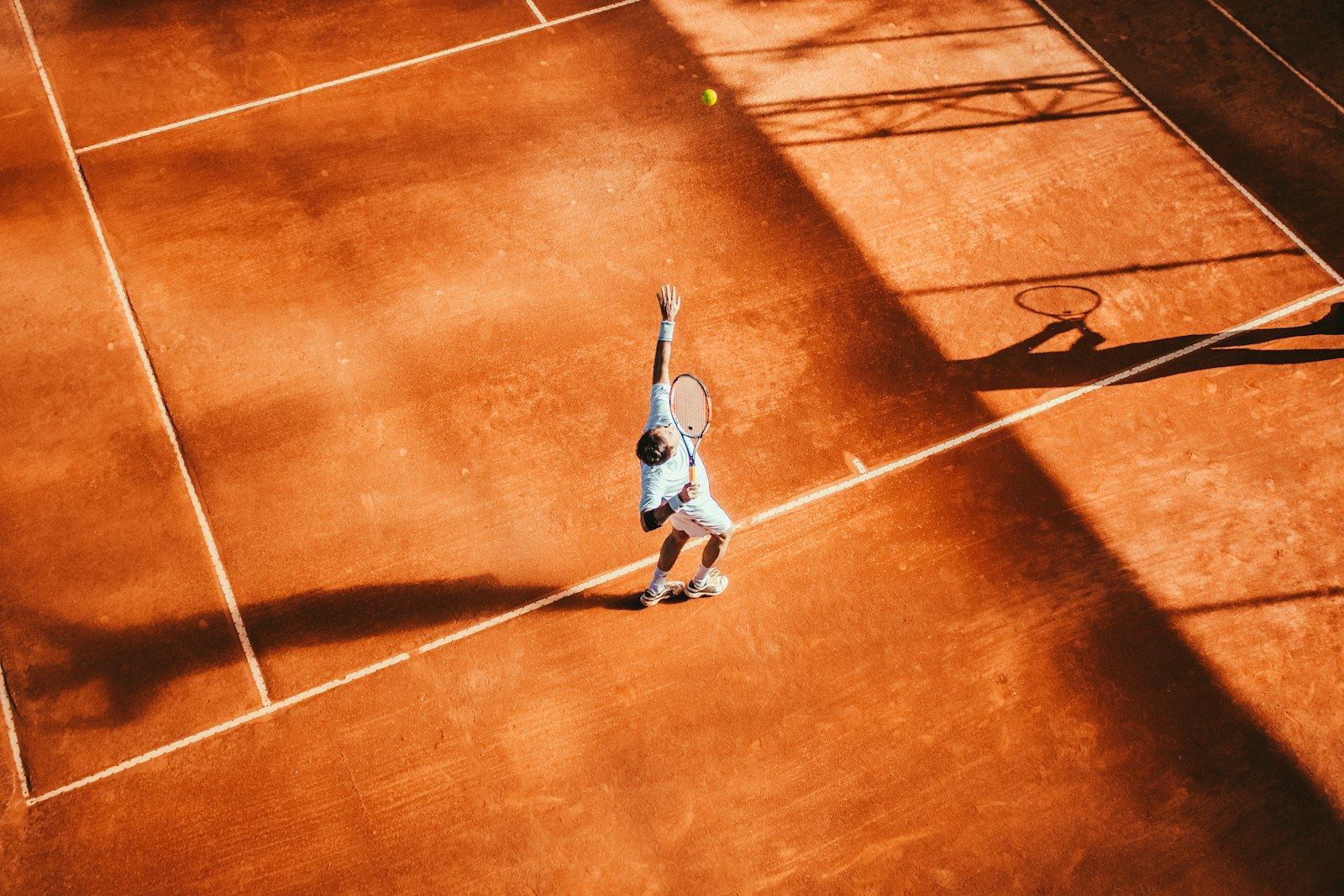
 Find Tennis Opens
02The objective
Hit the ball over the net into your opponent's court so they can't return it before it bounces twice. Rallies build points, points build games, games build sets, sets build the match. The ball may bounce once at most on your side — or you can volley it out of the air.
Outlast them
Deep, consistent groundstrokes force errors. At amateur level, the player who misses less wins.
Finish up close
Volleys cut the court's angles off. Approach on a short ball, punch the volley away.
Free points
The only shot you fully control. A reliable second serve wins more amateur matches than a flashy first one.
01The court & the basics
One court, two widths — the tramlines only count in doubles. Figures below are from the ITF Rules of Tennis.
- Court — 23.77 m long8.23 m wide for singles, widening to 10.97 m for doubles.
- Net — 0.914 m at the centreRising to 1.07 m at the posts.
- Service boxes 6.40 m deepMeasured from the net. A serve must land inside the diagonal box; rallies use the whole court.
- Any part of the line is inIn un-umpired opens you call your own side — and if you're unsure, it's in.
03The scoring ladder
Three nested layers: points → games → sets. The weird numbers only live in the bottom layer.
04Serving — a service game, animated
Singles: P1 serves the whole game, alternating sides of the centre mark after every point — deuce box, then ad box. Doubles adds P2 and P4 at the net, but only server and receiver positions are fixed.
- Behind the baseline, diagonal targetServe from behind the baseline into the diagonally opposite service box. Points alternate right (deuce) side, then left (ad) side.
- Two attemptsMiss the box on the first serve, take a second. Miss both = double fault, point gone.
- Lets are freeServe clips the net cord and still lands in the box? Replay it — no limit, no penalty.
- Feet stay putTouching the baseline before contact is a foot fault — it counts as a missed serve.
- Service alternates by gameYou serve a full game, then your opponent serves one. In a tiebreak it flips every two points.
05How points are lost
Get there in one
Ball bounces twice on your side — point over, even if you scoop it up a millisecond late.
Beyond the lines
Your shot lands outside your opponent's court (singles lines in singles, tramlines included in doubles).
Into or touching
Shot into the net loses the point. So does touching the net or crossing onto their side while the ball is live.
Racket only
Ball grazing your body or clothes = opponent's point, wherever you're standing.
One clean strike
Deliberate double contact is a fault. (An accidental double-hit in one motion is legal — rare trivia.)
Legal, annoying
Unlike the serve, a rally ball that clips the tape and dribbles over is completely fine. Play everything.
06Formats you'll meet in opens
Best of 3
Two full sets, 10-point match tiebreak if it's one apiece. The weekend-league default.
Sets to 4
First to four games, tiebreak at 3–3, often no-ad scoring: deuce = one deciding point, receiver picks the side.
One set to 8
A single long set to 8 games — common in box leagues and time-boxed court slots.
07Quick FAQ
Who calls the lines with no umpire?
Each player calls their own side, out loud and promptly. The etiquette is absolute: if you're not sure, the ball was in. Persistent bad calls are how you never get invited back.
What's the difference between deuce and no-ad?
Traditional: at 40–40 you must win two points in a row. No-ad (common in doubles and Fast4): the very next point wins the game, and the receiver chooses which box it's played to.
Do doubles partners take turns hitting?
No — unlike table tennis, either partner may hit any rally ball. Only serving and receiving positions are fixed within a game.
Which balls should I bring?
Tournaments provide match balls. For practice, pressurised balls go dead in a few weeks once opened — check the can date, and expect a slower, higher bounce on clay than hard courts.
08What's new · latest regulations
Two changes have reshaped how modern tennis is decided and officiated — both now standard across the pro tours and filtering into amateur opens.
10-point final-set tiebreak
All four Grand Slams now settle a 6-6 final set with a first-to-10 tiebreak (win by 2). No more marathon deciding sets — expect the same in most opens.
Electronic line calling
Most pro events — including Wimbledon — have replaced line judges with automated calling, so there are no player challenges at those tournaments.
No-ad & Fast4
Amateur draws increasingly use time-savers: no-ad deciding points at deuce, Fast4 sets to 4, and a 10-point match tiebreak instead of a third set.
★Ref Test — prove you know it
Ten questions straight from the official rulebook figures on this page. Score 80% or better to earn your badge and XP. No signup — progress saves on this device.