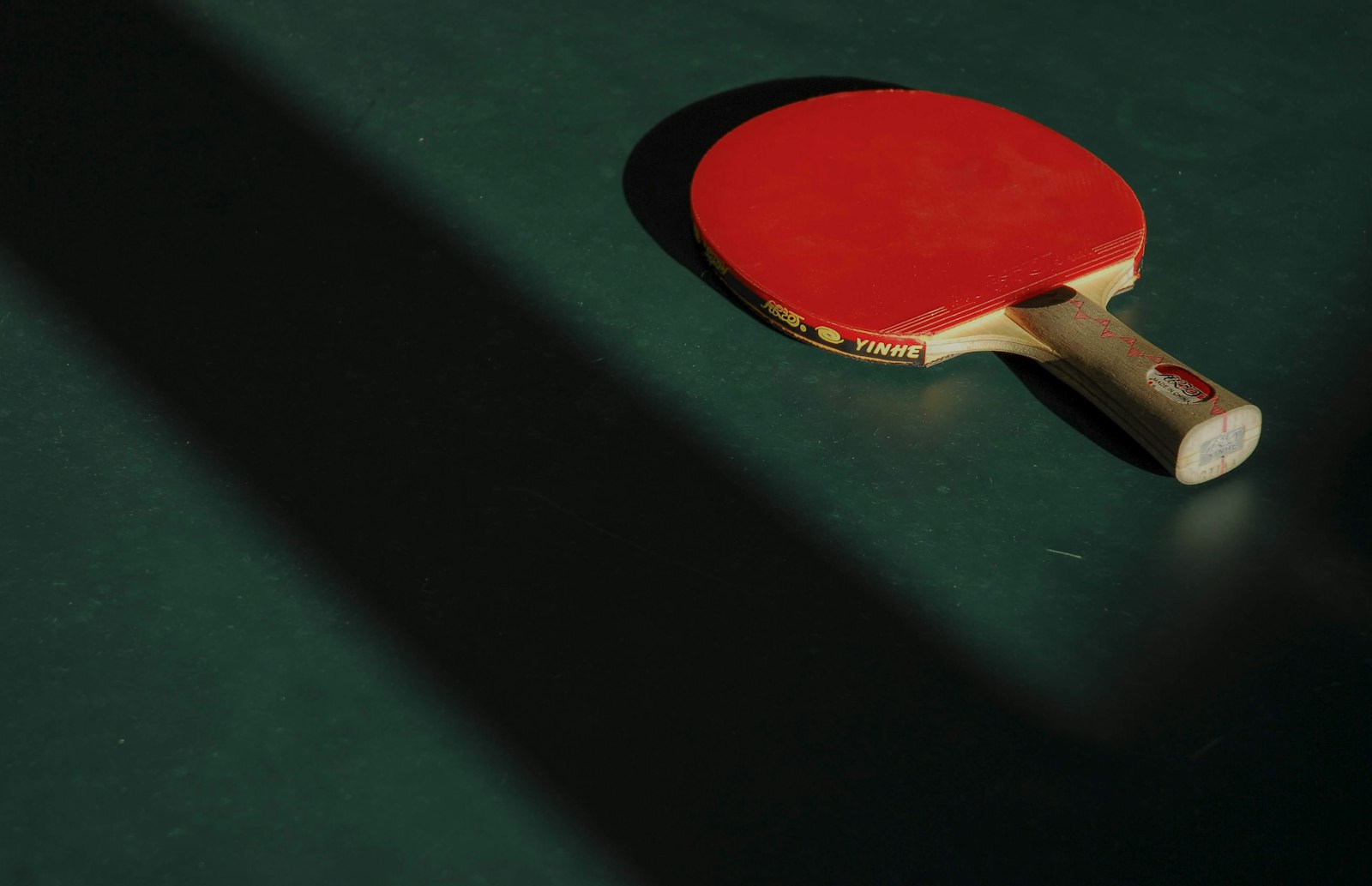
 Find Table Tennis Opens
02The objective
Hit the ball over the net so it bounces on the opponent's half and they can't make a legal return. Every shot must bounce exactly once on your side before you strike it — there are no volleys in table tennis. Hitting the ball before it bounces (even standing well back) loses you the point.
The invisible weapon
Rubber-coated paddles produce vicious topspin, backspin and sidespin. Reading spin off the opponent's paddle angle is the core skill.
Wide, deep, or at the elbow
The table is small; angles and depth beat raw speed. The crossover point (playing elbow) is the classic target.
Fastest sport per metre
Rallies live on reflex. Stay square, strokes compact — a big tennis swing has no time to recover here.
01The table & the basics
Everything you need before your first match. Figures below come from the ITTF Laws of Table Tennis.
- Table — 2.74 m × 1.525 mStanding 76 cm off the floor. The white edge lines are part of the playing surface.
- Net — 15.25 cm highStretched across the width, with the posts overhanging each side.
- The 16 cm tossThe serve must rise at least 16 cm from an open palm, near-vertically, and be struck on the way down.
- The expedite ruleIf a game is unfinished after 10 minutes (and fewer than 18 points scored), serves alternate every point — and if the receiver makes 13 good returns, they win the point.
03Scoring — the race to 11
04Serving — stricter than you think
- Open palm, ball visibleRest the ball on your flat, open palm, above the table level and behind the end line — no hiding it in your fingers.
- Toss at least 16 cm, near-verticalThe ball must rise 16 cm+ from your palm and be struck on the way down. Serving straight out of your hand is illegal.
- Bounce both sidesThe serve must bounce on YOUR half first, then the opponent's — the only shot in the game that touches both halves.
- No hiding the contactYour free arm must clear out after the toss; hiding the ball with your body is a fault at every serious event.
- Let serves: unlimitedServe clips the net but lands legally? Replay it, as many times as it happens — unlike badminton or pickleball.
05Rally rules & faults
Let it bounce
Striking the ball before it bounces on your side — even beyond the end line — loses the point. (If it misses your table entirely and hits you, that's the opponent's miss.)
Don't touch the table
Your non-paddle hand may never touch the playing surface mid-rally. Leaning on the table = point gone.
Or the net
Jolting the table or touching the net assembly during a rally is a fault — lunges have consequences.
Legal!
A wide ball may travel around the net (outside the posts) and land on the table — legal and spectacular.
Fingers count
A ball hitting your paddle hand below the wrist is a legal return. Anywhere else on your body: fault.
Accidental is fine
An unintentional double contact in one stroke is legal; deliberate steering with two touches is not.
06Doubles — strict alternation
- Partners MUST alternate every shotUnlike tennis or badminton, you and your partner take strict turns hitting the ball — no poaching. Hitting out of turn loses the point instantly.
- Serve right half to right halfEvery doubles serve goes diagonally from the server's right half-court to the receiver's right half (that centre line suddenly matters — a serve landing left of it is a fault).
- Rotation carries between gamesServing order rotates so everyone serves to everyone across the match; pairs swap who receives first each game.
07Quick FAQ
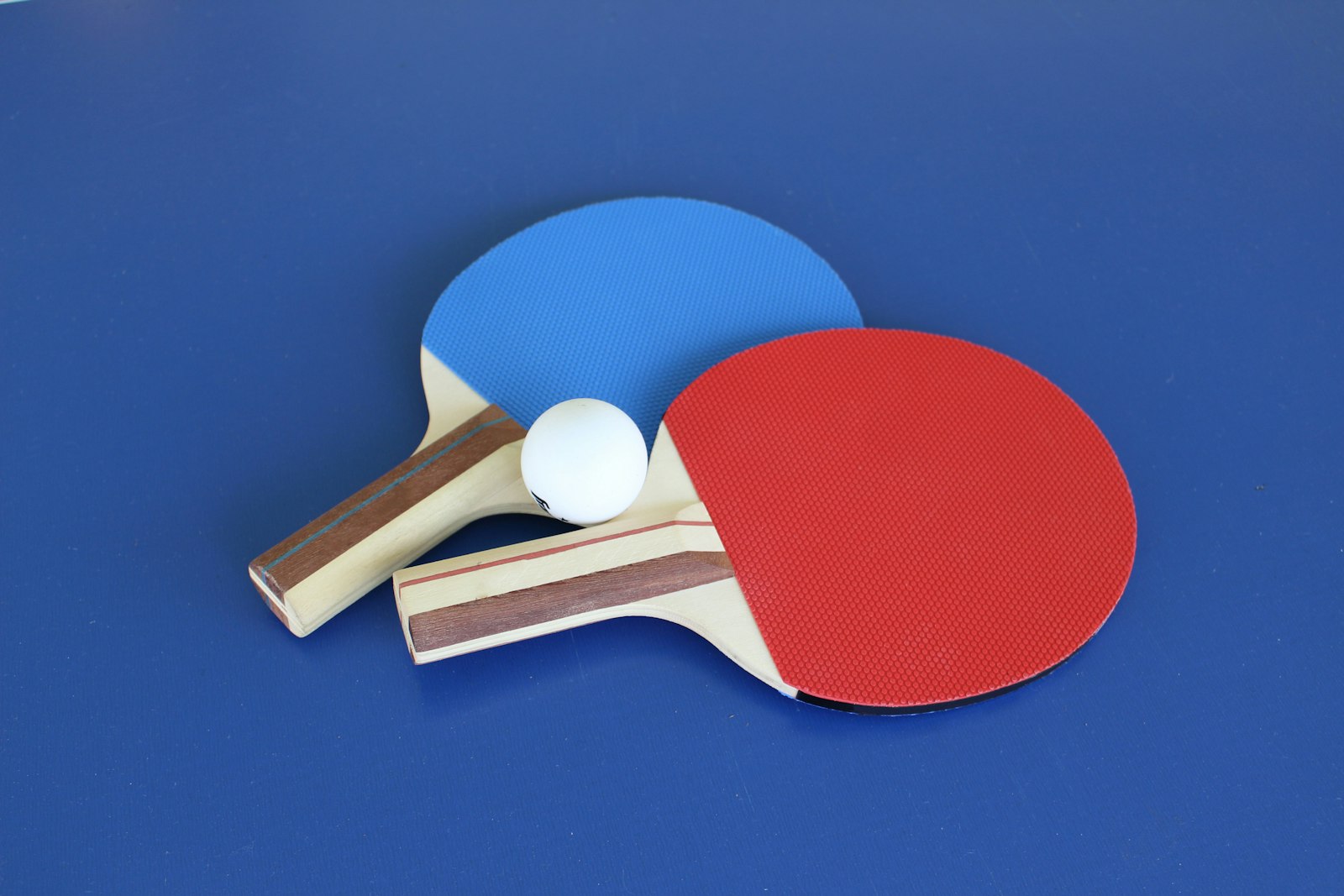
Why is one paddle side red and the other black?
The two rubbers may have wildly different properties (spinny vs dead). Colour-coding lets opponents know which rubber struck the ball. Flipping the paddle mid-rally to disguise spin is legal — and a classic trick.
Is "ping pong" the same as table tennis?
Same game — "ping pong" is the informal name (and a trademark in some countries). Competition play says table tennis; your office tournament can say whatever it likes.
Can I lose on a serve fault at match point?
Yes. An illegal toss or hidden serve is a point to the receiver whenever it happens. Umpired events warn once at most; club opens are more forgiving — but learn the legal serve early and it never bites you.
What paddle should a beginner buy?
A pre-made "allround" bat (or a slow blade with control rubbers) around ₹1,500–3,000 beats any "7-star speed demon". Speed you can't control donates points; spin and consistency win amateur brackets.
08What's new · latest regulations
Table tennis rules are stable, but the ITTF has tightened how the serve toss is judged — the fault most likely to catch you at an umpired event.
Legal serve toss defined
The "near-vertical" toss is now a hard number: within 30° of true vertical, measured by digital protractor during video review. Angled tosses are faults.
40+ poly ball
The 40 mm plastic (poly) ball remains the standard; celluloid is gone. It flies slightly slower with less spin than the old ball.
Games to 11
The 11-point, best-of-5-or-7 format (win by 2) is unchanged — the same across club opens and world championships.
★Ref Test — prove you know it
Ten questions straight from the official rulebook figures on this page. Score 80% or better to earn your badge and XP. No signup — progress saves on this device.